Wednesday, 11 March 2015

The Awakening


All around us right now is the slow but sure dawning of Spring, you can smell it on the breeze and feel it in the warmth of the sun and best of all; you can see evidence of it just about anywhere you look.  Wandering around our sites I have been thriving on the blue skies and warm winds that have blessed us for the last couple of weeks and the midge bites and freckles I have developed as a result are definite proof of seasonal flux.

Walking through the Duck Grounds on my birthday recently I was treated to my best ever sighting of a Kingfisher.  Like a silent jewel it sat on a twiggy perch gazing at the stream below it, its beady gimlet eyes watching for a tasty snack.  Normally I only see Kingfishers as passing streaks of sapphire so to actually get to watch one sitting still apparently oblivious of me was a treat indeed.  I also then spotted a Goldcrest hopping through the bramble and through my binoculars I could see the bright gleaming yellow crest on its head that makes this bird so distinctive.  The Goldcrest vies with the Firecrest for the title of the UK’s smallest bird, but Firecrests are far less common than Goldcrests.

I also admired the newly opened Hazel flowers on the trees, always a favourite Spring signal of mine; like a tiny fuchsia sea anemone, these iddy biddy flowers poke out the top of Hazel buds and are the ‘female’ part of the plant, to the ‘male’ catkins.

Whilst admiring all this in the Duck Grounds, I also had the added pleasure of Sparsholt students who were helping us to clear back the overgrown glade areas in time for the end of scrub cutting season.  These areas provide a good diversity within the peaty woodland habitat here and wild flowers and butterflies will benefit greatly from their re-opening.
Sparsholt have also been out on Stockbridge with me clearing back Sycamore.  Sycamore, like Birch, can be an ever advancing army which self-seeds and proliferates across a site and can take over and produce a very uniform, un-diverse one-type habitat if it is allowed to get too far.  Obviously I don’t want Stockbridge Down, a chalk grassland and mixed scrub habitat site to become taken over by Sycamore so we do clearance work to keep such species under control.  We had a great day in the sun and they did a brilliant job of clearing a patch of Sycamore that has been bugging me for a year or more.  We shall keep the regrowth sprayed with herbicide to kill it off completely and this should keep the tide back.


It gives me a good deal of satisfaction to stand on the top of Stockbridge Down, on the hillfort and look out across the site and be able to see the differences we have made.  I can spot the Juniper down the far end which are now not encased in scrub but stand out as the individual looking species that they are.  I can see the grassy glades in among the scrub areas which we keep open and which provide herb rich species for invertebrates including of course, butterflies.  I can see the rotation scrub work regrowing and providing differing habitat to the mature scrub.  I can see the sheep slope blooming green and fresh after they grazed it last year, and see the flock scattered like woolly blobs on the new slope area that they reside on this year.  And above it all I can always spot the fantastic array of avian life that thrives here; kestrels hovering above the grassland, Red Kites wheeling on the thermals, Skylarks trilling their beautiful twittering song that is so quintessential of English countryside and, the other day, I was treated to an aerial acrobat display by Buzzards.  I stood on the top of the hill and watched them fling themselves through the air, twisting and turning, tucking in their wings and plummeting headfirst to earth like a suicidal bullet before woooosh! They throw their wings out again and they are effortlessly borne aloft, seconds from death by impact, to ‘dance the skies on laughter silvered wings’ as the poem goes (High Flight, by John Gillespie Magee Jr, one of my favourite poems).  It was a warm sunny day with light winds and so who could blame them for making the most of their sky empire and rejoicing in the sun.  I felt rather land bound and heavy watching them and could only dream of what it must feel like to soar and swoop in such a way.
 
Swooping buzzards

Meanwhile, back at Mottisfont, Brimstones have been dancing through the staff carpark having emerged from the Ivy in which they had tucked down for the winter and their bright golden presence warms the cockles.  

We are finishing the winter works and the estate has been bustling with the last minute race to the finish line.  In Oakley copse and Spearywell woods we have had Harvester machines in, clear felling areas of softwood plantation which will be sold as timber, leaving the woodland to regenerate broadleaf native species.  Harvesters are AMAZING.  They are a huge machine which grabs a tree in its transformer like claws and ziiiing! A blade has nipped out and cut the tree at the base, detaching it from the roots. Then it turns it sideways and, using a spikey rolling mechanism the tree is rolled through the claws and snedded (side branches removed) in a few seconds whilst the blade ziiiing! -cross cuts the trunk at the same time.  In a matter of seconds you have gone from a standing tree to a pile of logs – a process which can take me about half an hour with a chainsaw, depending on how many side branches there are to remove!  I would like to bid for a harvester of our own but I think we are talking in the region of many tens of thousands of pounds, so I may have to start saving the pennies…

 
Harvester power!


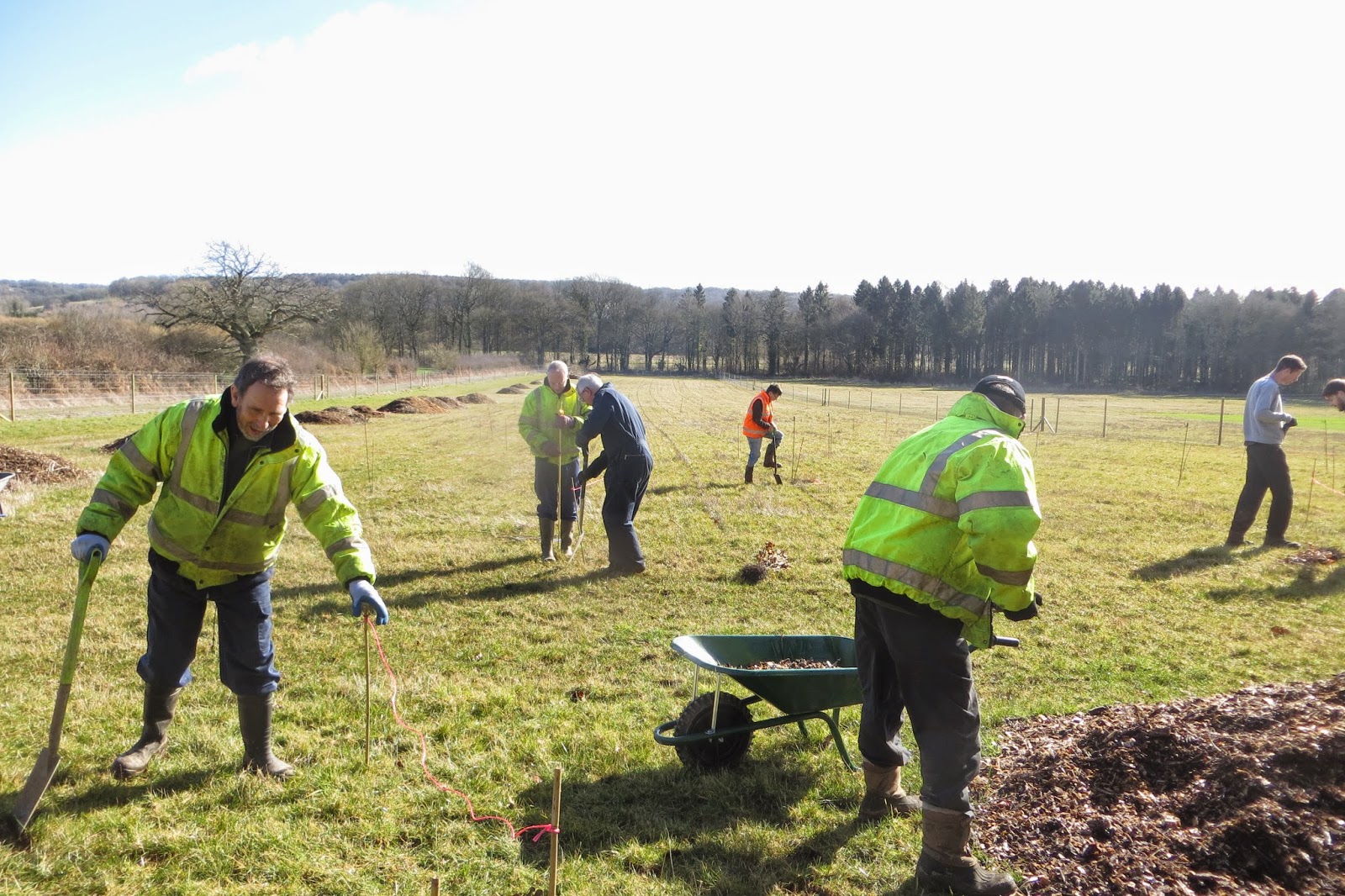
And whilst we are doing all this felling in the last gasp of winter, we are also planning for the future and creating life; tree planting.  As part of our Woodland Grant Scheme we are planting up a section of land that runs round the back of our Hazel coppice and was previously arable field.  The idea is that it will increase connectivity between woodlands and provide a future Oak timber crop in years to come.  I find there is something very satisfying and therapeutic about planting a tree – perhaps because so much of our work involves felling and clearing stuff, that to actually be putting something back into the ground and nurturing it gives me a sense of wellbeing.  Ryan has plotted and organised the tree planting and using his nifty method of stakes and strings to mark the spacing, both Monday and Thursday volunteers flung themselves into the task and did a brilliant job.  In two days we had planted almost all of the Oak species (English and Sessile) and other species are then to follow, including Holly, Hazel and Field Maple.  The mulch which we piled round the base of each tree comes from the brash we chipped from the coppice over the winter and which will do a great job of blocking weeds from growing up round the bases of the tree, as well as providing a nutrient filled mulch mat for the new tree to feed off as it rots down. 
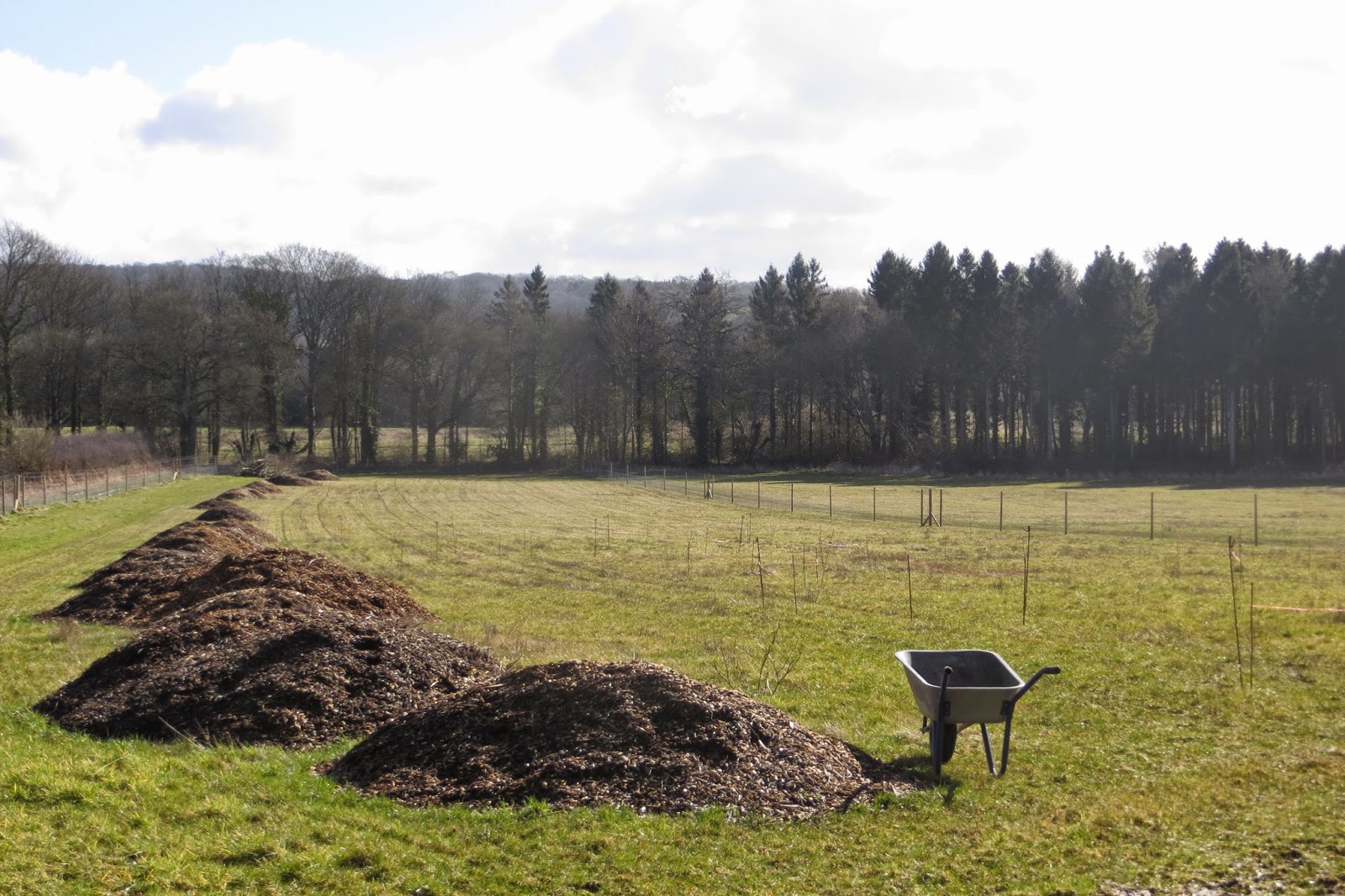
 
In the beginning there were mulch piles....


A team of willing workers...


A rare shot of riverkeeper Neil, doing something land based!


End of day one

Whilst we were planting up, there was a cry of ‘Frog! Frog!’ and a minute later two of the volunteers approached me, one of them with his hands clenched shut around something…not a frog as it turned out (this illusion was swiftly dispelled when they saw fur) but something that I had hoped to spot on our estate since I worked here….a teeny tiny harvest mouse!  It was most opportune as I had remarked to my friend only a few days before as we walked that field that it would be a perfect grassy verge for harvest mice in winter and so I was proved correct only two days later.  Harvest mice are our smallest UK mouse, weighing only 3-4g and with a fully prehensile tail which they use like a fifth limb to climb around in grasses and reeds.  In summer they frequent the reeds and grasses along ditches such as those we have in Long Lash and then in winter they move back a bit to drier ground.  I have always wanted to find a wild Harvest mouse as I love seeing things I haven’t found before and so I was jumping for joy over this tiny ball of ginger fluff.
The tiny Harvest mouse

Unfortunately wouldn't keep still for a good photo...
 
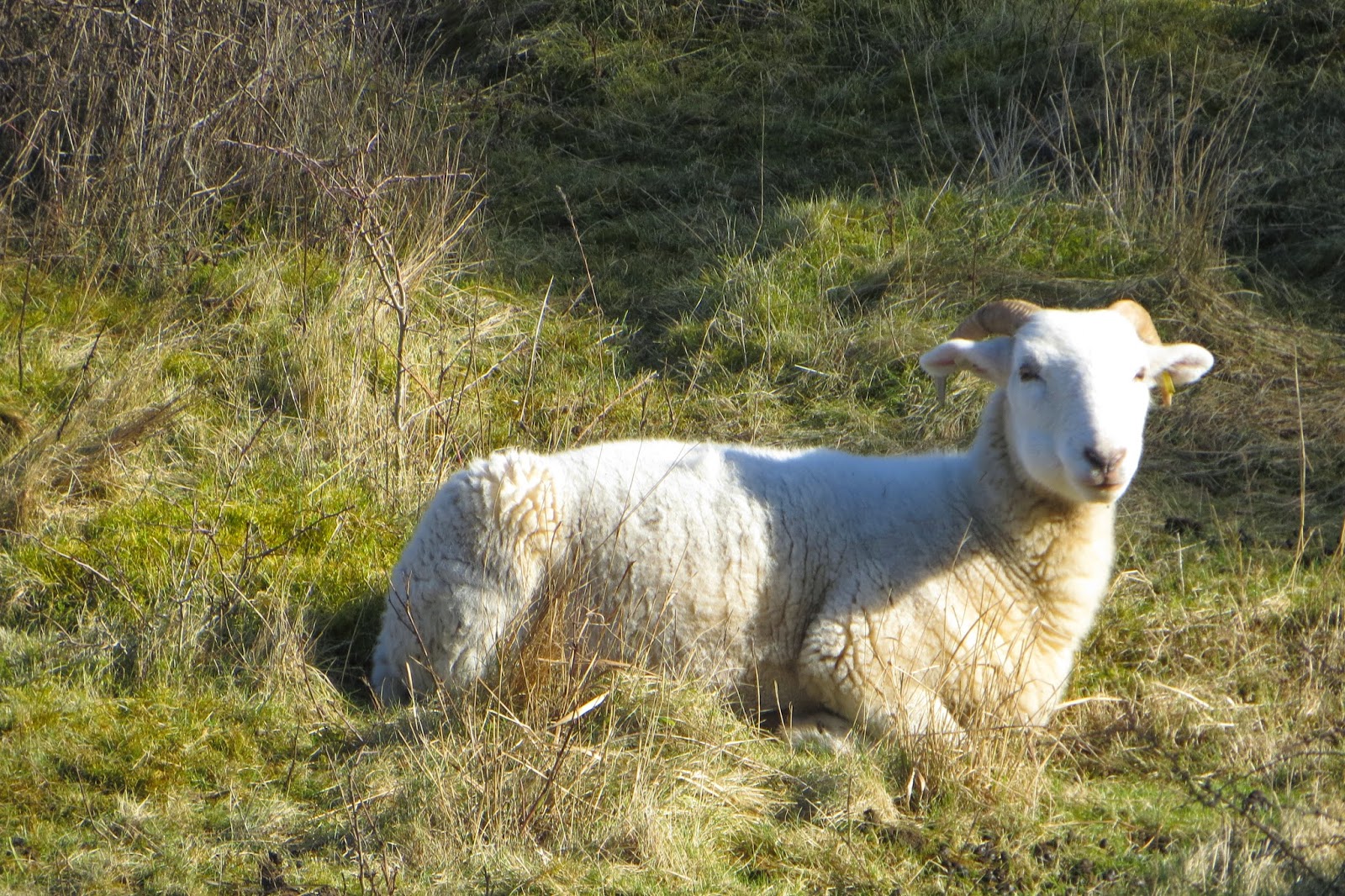
Finally I shall leave you with this picture of a very contented looking sheep, relaxing in the first warm sun of the year.  In a few weeks’ time they will start shedding their winter fleeces and we shall know that the warmer months have truly arrived.
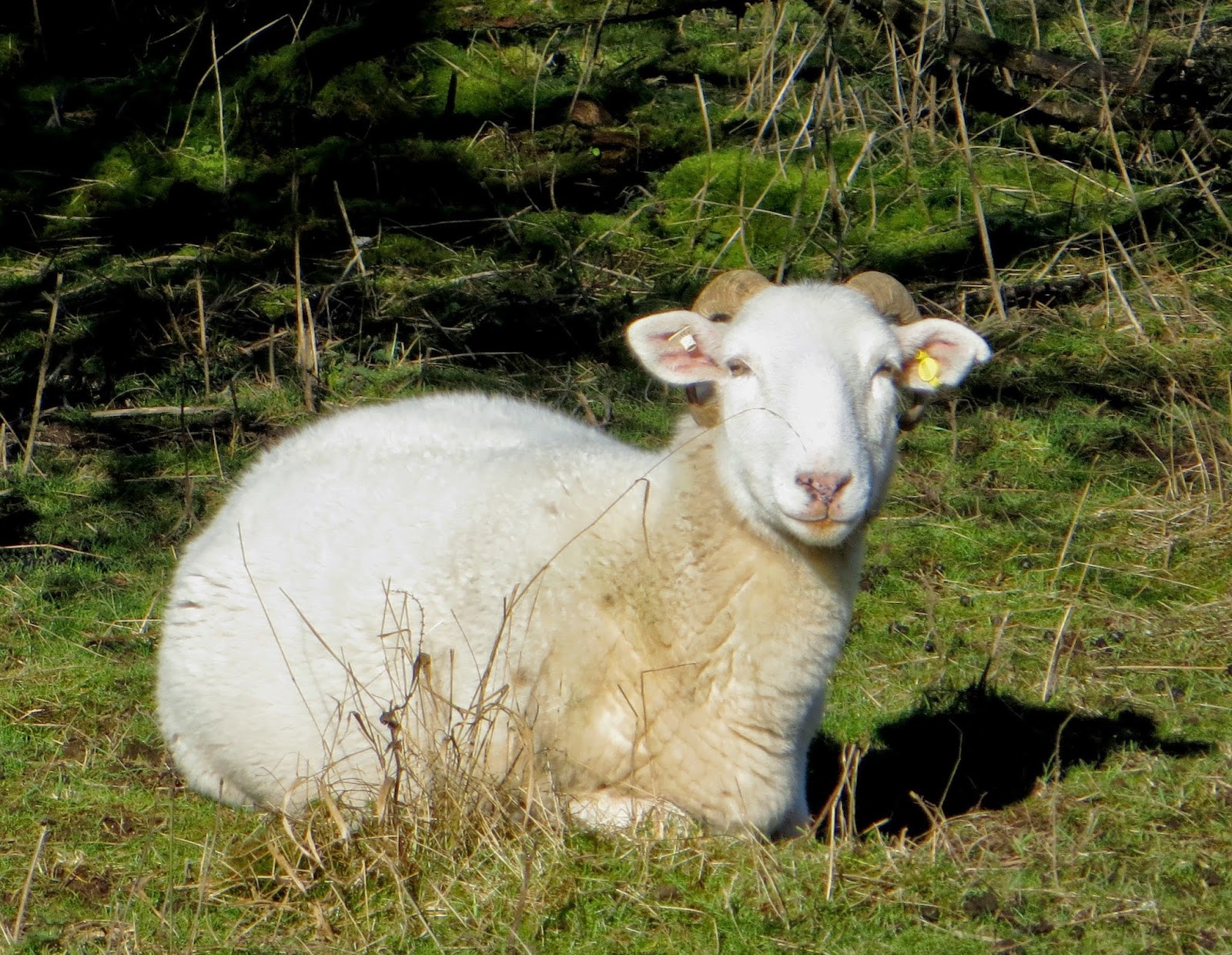
 
Looking like a fluffy puffball mushroom!


Monday, 23 February 2015

Winter's End


 'February is merely as long as is needed, to pass the time until March'
                                                                            J.R.Stockton


February has almost blown itself out with its bitter winds and March will be creeping in as of next week, bringing with it the promise of warmer sunshine and longer days.  Last week in Oakley copse Ryan, myself and Tony spotted our first butterfly of the year; a Red Admiral that must have been woken up from hibernation by the warmth of the sun that day and was dozily fluttering around us, probably slightly shell shocked after such a long nap.  It flitted right past my face (probably attracted to how sweaty I was after chainsawing, like a human salt lick) and seeing that jerky flight movement that is so characteristic of butterflies felt vaguely surreal; although you may see butterflies from March to October or beyond, so most of the year, the months when you are without them seem to feel like such a long time that when they do start reappearing, it’s like discovering a new species all over again!

In preparation for other small things waking up, Sparsholt students have been out with me for a tour of our woodlands and to help in setting up a new Dormouse survey grid.  As I have mentioned before, we have dormouse boxes in a couple of woodlands across our estate, in the hunt for these elusive little creatures.  They only went up last year and so it was unsurprising that no dormice were found using them last summer as it can often take a few years for them to move into the boxes. 
 
Sparsholt putting up Dormouse boxes
 
I have constantly found myself baffled though, at the lack of known dormice presence in our woodlands as we have everything they need (which, despite their name suggesting it, is not just Hazel).   However back in December, our deer stalker who works across our estate mentioned to me that he had seen a dormouse a few weeks previously, running along a fallen tree and down into a Hazel stool!  I resisted the urge to throttle him for not telling me sooner, as by the time I found out all dormice would have been tucked deep into hibernation – in fact that is likely to be what the one he saw was doing, looking for a spot to hibernate down in the roots of a hazel stool. So!  A first time sighting for the estate and one which I instantly set to work utilizing – I placed 50 nest tubes throughout this area of woodland and then Sparsholt have come out with handmade nest boxes and placed the beginnings of a new next box grid throughout the woodland too.  All I can do now, is sit back on impatient heels and wait for spring to come and for any dormice to start waking up and revealing themselves to me…unfortunately, patience is a virtue I am not renowned for!
 
Nest tube
 
Now, every other Sunday across our Mottisfont, Stockbridge and New Forest estates we work with SHNTV (South Hampshire National Trust Volunteers) doing various tasks throughout the year.  Last Sunday it was my turn to lead the day and we had the joyous task of removing old tree protection tubes and stakes from hedgerows around the estate that no longer required them.  If you drive round Mottisfont you will see hundreds of these tubes in the hedgerow, encasing a tree that has long outgrown it and doesn’t need protecting from rabbit damage anymore.  The plastic tubes are supposedly ‘biodegradable’ but I am yet to come across any that do in fact biodegrade within the life span of any human or tree – I reckon some will take hundreds of years to fall apart which isn’t much good as the tree inside will either be long dead or have grown over it!
So in order to rid our hedgerows of these plastic tubes – which don’t get me wrong are essential for newly planted trees, to avoid them being damaged by grazing animals – myself and the Sunday group set to work armed with penknives, Stanley knives, secateurs and eye goggles and, quite literally – dove in.  I found the best technique was to crawl into the centre of the hedge (which naturally had a good amount of thorn and friggin’ bramble within) and then crawl through the middle corridor slicing open the tubes with my knife and chucking them out through the branches.  I can see the appeal to wildlife in using the hedgerow as a corridor – it was quite cosy once you got inside!

 
Lurking in the hedgerow...

 The weather was cold but kind and we had a very successful day, clearing tubes from about 1.5km of hedgerow.  We stash the tubes until we have a big enough amount to take to a special recycling unit that will mash them up and reuse them – far more sustainable then letting them biodegrade for a thousand years in a hedgerow I reckon.

Last week saw our team travel to the far shores of Purbeck, to go and spend a day with the rangers at Studland clearing gorse from the sand dune heathland ecosystem.  The weather was truly glorious, with blue skies blazing and the sun beaming down – enough so that I was hoping to spot the first adders out basking, however I think we were making too much noise!  The Purbeck team came up to the New Forest a couple of months ago and did a day working with us, so this was our way of returning the favour.  

 
Waiting for the chain ferry - look at that blue, blue sky!
 

We took a minibus of volunteers with us, with Lee at the wheel (hence the fact they got lost around Ringwood and Poole) whilst Laura and I drove another truck down with more volunteers and all our tools.  When we got to the site the team gave us a brief talk about the habitat and the ecosystem – it’s not just any heathland site, but a sand dune heathland site which makes it that bit extra special.  Also interesting to learn was that elements such as the concrete pillar boxes which were onsite during the war and have since been blown up have meant that lime from the concrete blocks have, over many years, leached into the soil around it, changing its PH and thus allowing a wider diversity of species to grow here (heathlands are generally acidic, but the lime reduces this acidity which in turns allows different niche species to come in).  The site is also home to all six native British reptiles – much to my delight, I made a note to return here in spring and hunt them out.   

Our task was to assist in the cutting and clearing of degenerate, overgrown gorse.  Gorse is a brilliant habitat for reptiles on heathlands but it can get rather out of control and swallow up the heather and other species.  Due to the steeply undulating dune landscape the team here are unable to use machines to clear the gorse (and it would be too damaging to the dune habitat) so they can only cut and clear by hand.  So in we went, armed with chainsaws and bow saws and, having plotted out the area they wanted work doing, we attacked.  I found a great satisfaction in chainsawing my way across a swathe of hillside, piling up the cut gorse as I went, and looking back to see the trail we were carving. 
 
Ploughing our way through the gorse (photo credits: David Jones, NT)

 As well as the sandy soil the presence of hidden blocks of blown up concrete meant we had to be careful not to wreck our chainsaws by catching them which would inevitably blunt the teeth.  However I managed to avoid doing so until the very last moment, when I saw the sparks fly as a concrete lump leapt out of the gorse at me and just caught my saw.  The Purbeck team kept us well fed and watered throughout the day and we all had a great time – I couldn’t get over the beauty of the place and everytime I reached the top of a dune I would stand there gawping for a minute, at the rolling heathland, with the sandy beach beyond and Old Harry and his Wife standing guard out in the blue sea.  So a big thanks to the Purbeck team for having us and to our volunteers who risked Lee’s minibus driving to come and assist and when the weather turns truly warmer – I will be heading back to enjoy the site at its summer peak, with the coconut scent of gorse in my nostrils…
The devastation we left behind - an ocean of cut Gorse for burning...(photo credit; David Jones NT)
 

Finally, take note of our avian friends as winter draws to a close – I keep seeing a good number of birds on the lawns of Mottisfont that at a casual glance may be mistaken for Song Thrushes, with their speckled breasts.  However if you stop and look you will spot the beautiful russet red feathers on their sides which identify them as Redwings, our smallest UK Thrush and a winter visitor from the North.  They will be leaving soon, throughout March and April, so enjoy them whilst you can as they are a delightful bird.


Redwings on the lawns of Mottisfont
 

And talking of feathered friends, if any of you have read my blog long enough to remember the tale of ‘Goldie’ the Goldfinch I rescued back in April 2013, then I am delighted to report that according to the Mottisfont Bird Report 2014 (compiled by Alan Snook) Goldie was spotted again in 2014 at the bird feeders at Visitor Reception.  Goldie was found unconscious with a damaged wing in the grounds of Mottisfont and I took on the task of taking him home, sorting his wing out and keeping him for a month until it healed.  Once he was able to fly again I released him back where he was found and he was seen later that year with a flock of finches, recognisable by his wonky wing which although healed, is now always held at a slight angle to the other.  The last I heard of him was at the end of 2013 so I was thrilled when I read Alan’s report that showed he had been seen again in 2014 in a winter flock – gives you a real glow of pride!   And fingers crossed that Jasper, the Nuthatch I reared last year will make an appearance this Spring back at his birth tree, as I would love to see him again and know how he is getting on – although this isn’t some modern day Snow White story where all the small birds I’ve saved will flutter round me singing sweet ballads, so I will probably never know their fate – but it doesn’t stop me keeping my ears open for the call of a hungry Nuthatch or my eyes peeled for a wonky winged Goldfinch and a familiar feathered face.


Friday, 6 February 2015

The Year of the Sheep...


Brrrrrrrrr!  The last couple of weeks has reddened our noses and frozen our digits as snow, sleet and bitter winds have all graced us with their presence.  I have taken to wrapping my feet in newspaper inside my wellies for insulation, and we have all turned into hooded, scarf over face people, from which only a peeping pair of eyes is visible.

One of my sheep lookers pointed out that February 2015 is the beginning of the Chinese New Year, which this year is – the Year of the Sheep!  As a result we felt that part of this blog post dedicated to the flock was a worthy tribute, in honour of our Ovine workers.  Over the year many of them have been given names, by either myself or the lookers as each individual character or appearance became more recognised.  Such names include:
Boadicea (the leader of the rebel pack)
Margo/Maggot Neck (our fly strike victim who I call Maggot Neck, but our sheep lookers changed it to the more pleasant Margo)
Fatty Boom (Our plumpest girl who never loses weight)
Walter (The Wether, sole male of the flock)
Bigfoot (named obviously for her large camel like front feet and the fact she will follow you to the ends of the earth for the nut bucket)
And no doubt more will follow as they each develop their own perks.

When the snow fell the other day I took up bales of hay to the flock as they were unable to graze the grass and I was met by 28 rather cross sounding bleating sheep who seemed to be implying that I should have got there much sooner and didn’t I know how hungry they were?  I filled their corral with hay, added some sheep nuts for good measure and then was consequently trampled by the resulting stampede as I opened the gate to let them in.  After picking myself up and picking off the clumps of frozen dung I’d fallen in, I then inspected their water bowser which had frozen up.  


I smashed the ice layer and scooped it out, nearly losing a finger to frostbite in the process – you can see from the above picture how thick the layer of ice can get here – being a North facing slope, it seems to take a while longer for everything to thaw out.  The girls seemed suitably appeased with their snouts deep in hay and I admired their thick winter fleeces that enable them to stay warm and cosy on that bitter snowy slope.
 

From snow to Snowdrops – it’s that time of year again where the first little hints of spring have poked their way up through the soil in the form of pure white snowdrops.  Each year we do Wild Snowdrop Walks from Mottisfont grounds across to one of our private woodlands.  These are organised by myself and our Visitor Experience team and then facilitated by our Outdoor Guide volunteers who lead the walks across the weekend.  Walks are on the 7/8th Feb and 14/15th Feb at 10.30am, 12.30pm and 2pm – from within the pay zone.  I walked the route the other day to ensure it was all ok and enjoyed the site of a beautiful white carpet of flowers, spread out in the dappled sunlight beneath the canopy.  Whilst I favour bright yellow daffodils as my favourite flower, you really can’t help but feel joy at the site of snowdrops – a visual feast for the eyes after the long winter, they are a little signpost on the road to Spring.


I was driving around the Mottisfont estate the other day, taking the chance to check in on some of the sites I hadn’t got to for a while.  I headed to Oakley plantation, a small woodland of ours that is a mix of coniferous plantation and out-of-rotation hazel coppice with standards.  Ryan and the volunteers have been working hard to start sorting this woodland out, by bringing the coppice back into a rotation and removing the softwoods which Dave then sells for logs and timber.  Sparsholt College have also been helping us fell the softwoods here as part of their chainsaw training courses, so everybody gets a benefit.
Last year we coppiced the first section of the woodland and this winter Ryan and the volunteers have just completed another section, as well as removing a load of softwood.  I hadn’t got there for a good few weeks so went along the other day to have a nosey and was gobsmacked by the amount of work that had been done and how good it looked.  The section they have cleared this winter is a fairly large section and is now ready for deer fencing to be installed.  The wood has all been sorted into piles for charcoal making and it all looks fantastic – considering when I was last there it was a tangled mess of overgrown hazel, softwood and birch!  I cannot wait to see the ground flora that will pop up in couple of months, now that they can reach the light….
 
The newly cleared section in Oakley
And in case you are wondering where the wood goes to be made into logs – Dave extracts it to our wood yard where he and our wood yard volunteers then spend many happy hours (boys and toys!) cutting them to length and putting them through the log processor which spits them out as beautiful logs, perfect for your wood burning stove or fire place.  Below you can see Phil and Alan our volunteers, in action, ploughing their way through the timber pile and creating wooden money.
 
From wood to fireplace...

 Another place I visited whilst roaming the estate was the Oakley Oak.  I felt it was high time I reacquainted myself with this magnificent tree beast to see how it was doing during winter and also to check the Barn Owl was still in residence.  I walked beneath its gargantuan boughs and marvelled, as I always do, at its presence, from the huge knobbly root buttresses, worn smooth from hundreds of years of people sitting on them, to the craggy hollow limbs that extended skywards.  Beneath one limb I found a pile of Owl pellets (the small bundles of indigestable fur and bone that they regurgitate) which reassured me that the Barn Owl was still doing well and remained tucked up in his chosen limb and as always put the nursery rhyme in my head: ‘A wise old owl, lived in an Oak.  The more he heard, the less he spoke. The less he spoke, the more he heard – why can’t we all be like that wise old bird?’
Examining the pellets I found shrew, vole and mice skulls (you can especially tell shrew skulls as they have red tipped teeth) which seemed to point to a good supply of food.  I then clambered up into the arms of the tree and found several more areas of pellets which could either mean the owl is perching from several roosts, or that there is more than one using the tree which would be excellent news. 
 
Owl pellets - spot the skulls!

As I sat in the branches of that ancient Oak I looked out at the river which rippled alongside it, crystal clear and musical, and at the sunlit fields that surrounded it where cattle gently wandered.  Birds were singing and calling and the sun held the first hint of warmth I had felt in a long time and with this I felt my heart lift ever so slightly; Spring was coming.  We were almost there.

 
Our Oakley Oak